Published in Tickled by Thunder
Jerome loosened his wool robe and pushed back its hood. He sank heavily onto one of the steel benches which lined the stone wall, and ran a small, thick hand through the beads of sweat which clung to his shaved head. The heat alone in the Hall of Souls could be overpowering, but the dampness of the condemned added a crushing weight to the air that could be unendurable. The years had done nothing to lessen the discomfort Jerome felt in this place, and today, like every day, he prayed for his time to pass quickly.
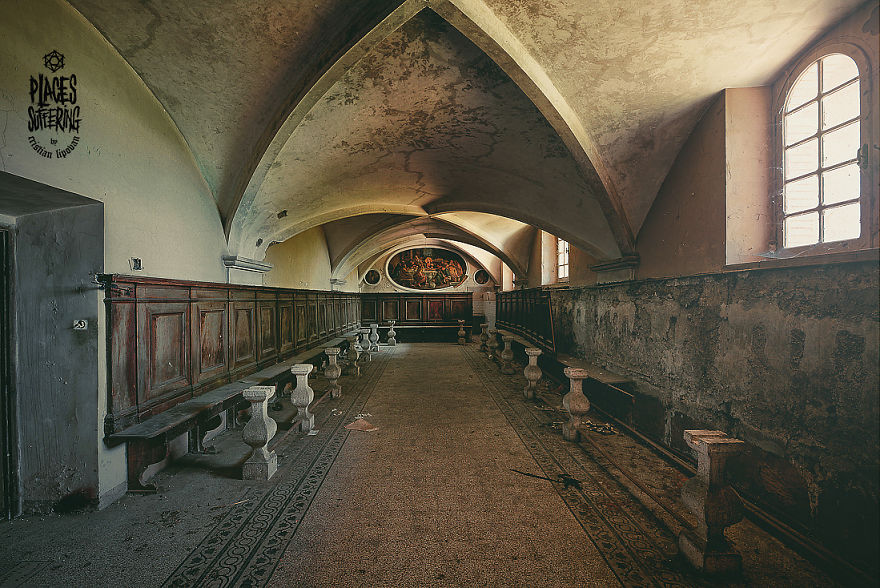
He was in a large, windowless room, constructed entirely of stone. He looked across to the opposite wall far away, where a window had once been, now bricked with stone and mortar. Behind that wall were fields and vineyards, and beyond, small groves of oak with sanctuaries nestled among the trees, connected by winding paths. How he longed to be done with his day’s toil.
He heard footsteps from the end of the hall, and he quickly stood. He slipped his hood back over his head and retied his robe. Bonaventure always found a reason to roam the halls in the waning hours of Jerome’s shift, and he would love to catch him resting. Bonaventure was the Abbot’s own sycophant, and he took sport in exploiting Jerome’s weaknesses. Jerome only wished that Bonaventure would leave him alone, find someone else to report to the abbot, ride someone else’s back up the Church’s hierarchy.
Jerome busied himself with the task of soul tending. As an obedient servant of the Brotherhood, he could not bring himself to say he actually hated soul tending, but there was nothing in his life he enjoyed less. He preferred the idyllic aspects of monastery life: baking bread, tending the vineyards, or just spending time in his room or wandering the winding paths, contemplating. But every time he stopped to rest, every time he slowed down in his soul tending duties, there was Bonaventure, ready to report him to the abbot. And with each report came more time in the Hall of Souls.
The stone walls climbed to vaulted, gothic arches, where they disappeared behind a snarled knot work of steel pipes. Waist-high basins were arrayed across the floor in a grid, like the tombstones of an insanely well-ordered cemetery. Each was filled with the warm, briny solution of unending life. Tubes hung from the pipes overhead, and dripped their loads into the basins with constant and unending drops. It was this sound which made the already distasteful job almost unbearable for Jerome. Each drop, by itself, was pleasant enough, but together! Together there were hundreds, thousands of drops, each echoing off the walls and floors, rising up into the twisted acoustics of the steel pipes, where the plinks and plops were transmuted and mixed into an unholy caterwaul.
The din inside the Hall of Souls was a mockery of the gentle rustling of leaves and grasses in the peaceful countryside all around.
Jerome continued with his rounds, checking each basin for pH, salinity, oxygen and other vital data, and adjusting the drips from overhead accordingly. He moved from basin to basin, dutifully reading the old-fashioned gauges, opening and shutting the valves. More oxygen, twist; less folic acid, twist; more vitamin E; drip drip drip. Technology had made the vocation of soul tending obsolete decades ago, and Jerome would happily have stood aside and let a machine take over. But the church insisted on the traditional ways. This was his lot, and being the obedient soul that he was, he accepted it.
Jerome looked down into one of the basins at the gray and wrinkled lobes floating in the brine. He had never gotten used to how small they looked. His hand reached up unconsciously under his hood and touched his smooth head.
He sensed that Bonaventure was watching him, so he continued his tasks without resting. He would not give Bonaventure an excuse to issue him more penance. He worked on industriously, moving from basin to basin, tending to the souls which had been condemned to unending life. The legal term was “life without death,” and over a hundred souls were in this room. The rest were placed in similar Abbeys across the country, tended by similar monks.
The souls, all convicted of the most terrible acts of violence or the most blasphemous heresies, crimes judged too infamous for redemption, had lost their right to die. They had forfeited their chance to cheat justice with a chopping-block repentance. Trapped in their corporal vessels, the souls floated in their basins, wires and electrodes monitoring their vital data. The tubes hanging from the ceiling were the chains which bound them to this world. They delivered the sustenance; the oxygen, the vitamins, the nutrients to keep them alive for eternity. And there they floated, no eyes to see, no fingers to touch, no noses to smell the world which refused to let them go.
Jerome wound his way through the rows, eyes fixed on his task, until he was stopped by the specter of Bonaventure, looming at the end of the aisle.
“Brother Jerome,” he said in his officious voice, “the Abbot is here, and the heat is affecting him. Run and fetch a cup of cool water. Be quick, or you’ll never see the outside of this building again.”
The abbot, here! The abbot had not been to the Hall of Souls in years. He was over eighty, and the wetness of the air plagued him. Jerome quickly turned and ran through the hallway to the kitchen, where he filled a tall cup from the wooden sink. He hurried back, but before he entered the Hall of Souls he stopped himself. Why was he hurrying? To hand the water to Bonaventure so he could quench the abbot’s thirst? So Bonaventure could curry more favor from the abbot and gain more power over Jerome?
Jerome entered the Hall of Souls unnoticed. Bonaventure was in conversation with the abbot, their faces completely obscured by their hoods. Jerome slipped across the floor to the nearest basin. He emptied the cup into the bowl, and quickly moved to the next. He scooped a cupful of liquid from the basin, and hurried across the Hall of Souls, and panting, handed the cup to Bonaventure.
 Unstoriable